
This page contains affiliate links. See our affiliate disclosure.
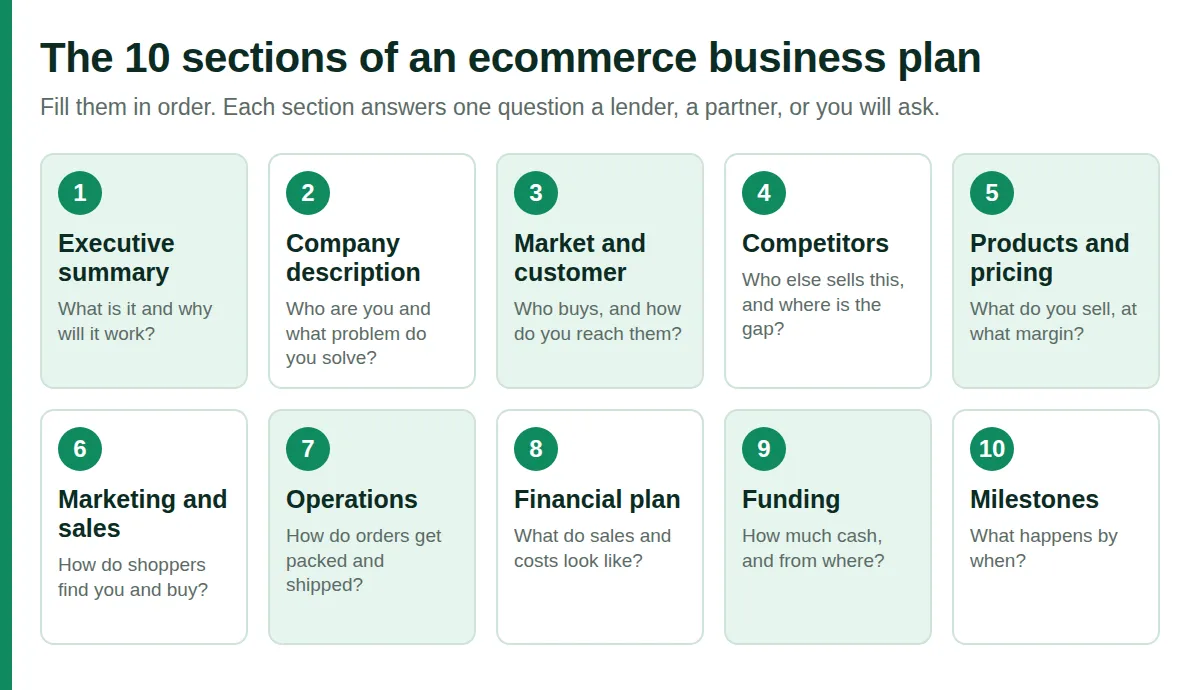
Quick answer: An ecommerce business plan has ten sections: executive summary, company description, market research, competitor analysis, products and pricing, marketing, operations, financial plan, funding, and milestones. Fill each one with your own numbers: conversion rate, average order value, product cost, and ad spend. Use a one-page version to test an idea and a full plan for lenders.
An ecommerce business plan is a short working document that explains what your online store sells, who buys it, how shoppers will find you, and how the money works. This guide gives you a fill-in template for each of the ten sections, plus a complete worked example for a hypothetical Shopify store called Trailhead Tea Co., so you can see real numbers next to every prompt.
The market is large and still growing. The U.S. Census Bureau reports that e-commerce was 17.1% of total U.S. retail sales in the second quarter of 2026 (seasonally adjusted), or about $340.2 billion in that quarter. A big market is not a safe bet. Bureau of Labor Statistics data show that 77.9% of private-sector establishments that opened in the year ended March 2024 were still open a year later, and 51.4% of those that opened in the year ended March 2020 had survived five years. Those figures cover all industries, not only online stores. A plan cannot guarantee survival, but it exposes weak assumptions before you spend money on them.
Important: every name and number in the example store is invented for illustration. They are assumptions, not industry benchmarks. Replace them with your own research.
Why an online store needs its own kind of plan
An online store makes money differently from one with a lease and foot traffic. Revenue comes from website traffic multiplied by conversion rate and average order value. Inventory ties up cash before the first sale. Shipping and payment fees sit inside your margin, and advertising is usually your largest variable cost.
Shopify's guide to writing a business plan makes the same point: it recommends ten steps, from choosing a format through market analysis, a marketing plan, a logistics and operations plan, and a financial plan, and ends with regular updates. The U.S. Small Business Administration (SBA) adds a practical reason to write it down. Its funding guidance says lenders look for a business plan, startup cost calculations, financial projections, and a break-even analysis.
Which format to use: one-page plan or full plan
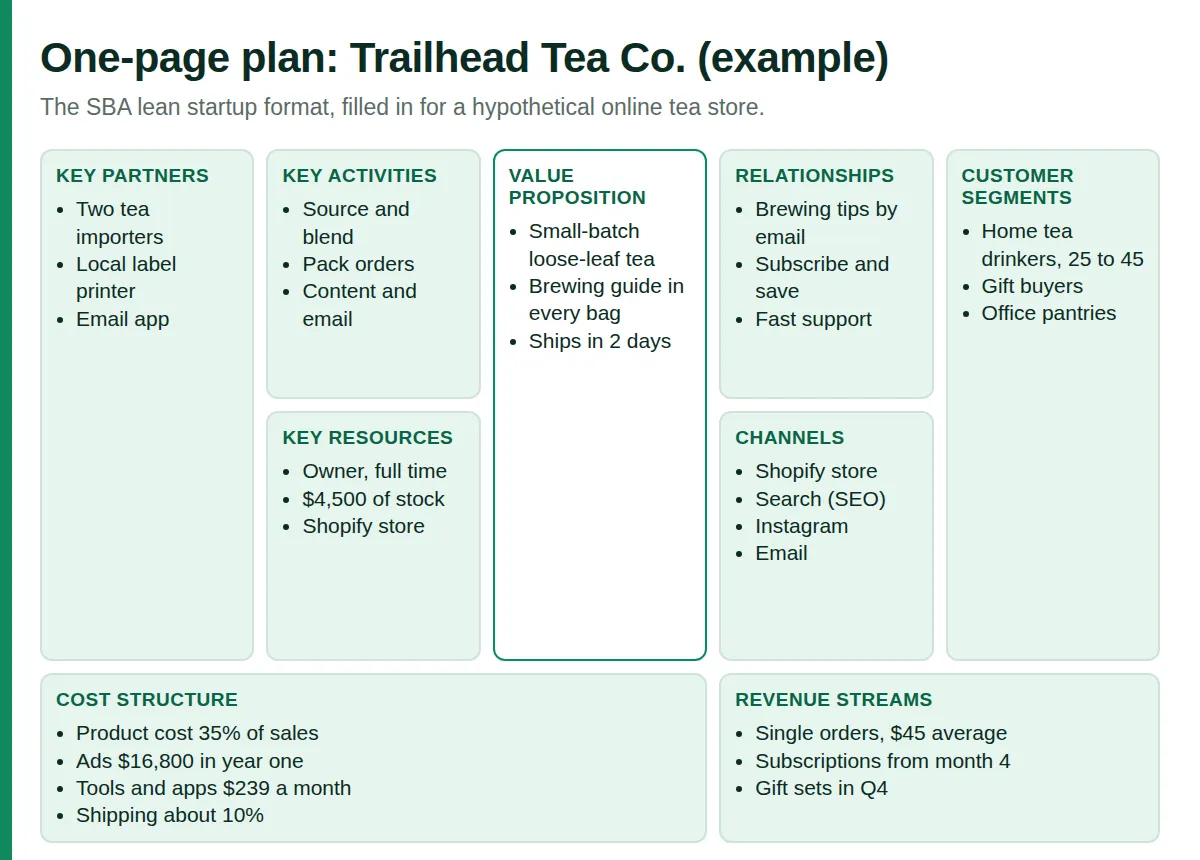
The SBA describes two formats. A traditional plan is detailed and comprehensive, and lenders and investors commonly ask for it. A lean startup plan is high level and quick to write, usually about an hour on a single page, built from nine blocks: key partnerships, key activities, key resources, value proposition, customer relationships, customer segments, channels, cost structure, and revenue streams. SCORE, the nonprofit mentoring network, also offers a free business plan template for startups, and Shopify publishes its own business plan template and a guide to the lean business plan.
Write the one-page version first, because it forces clear choices in an hour. Expand each block into the full sections below once the idea survives early research.
How to use this template
- Work through the sections in order, but write the executive summary last.
- Copy each template block and replace every [bracketed] item.
- Write the source next to every number: a supplier quote, a public statistic, or a labeled guess.
- Mark unknowns as "TBD" and note how you will find out.
- Review it every quarter and after any large change in costs or sales.
Meet the example store
Trailhead Tea Co. is a made-up online store that sells small-batch loose-leaf tea in the United States. It launches in January on a Shopify store, run by one founder. These assumptions drive every number below.
- Average order value (AOV): $45, about three items per order.
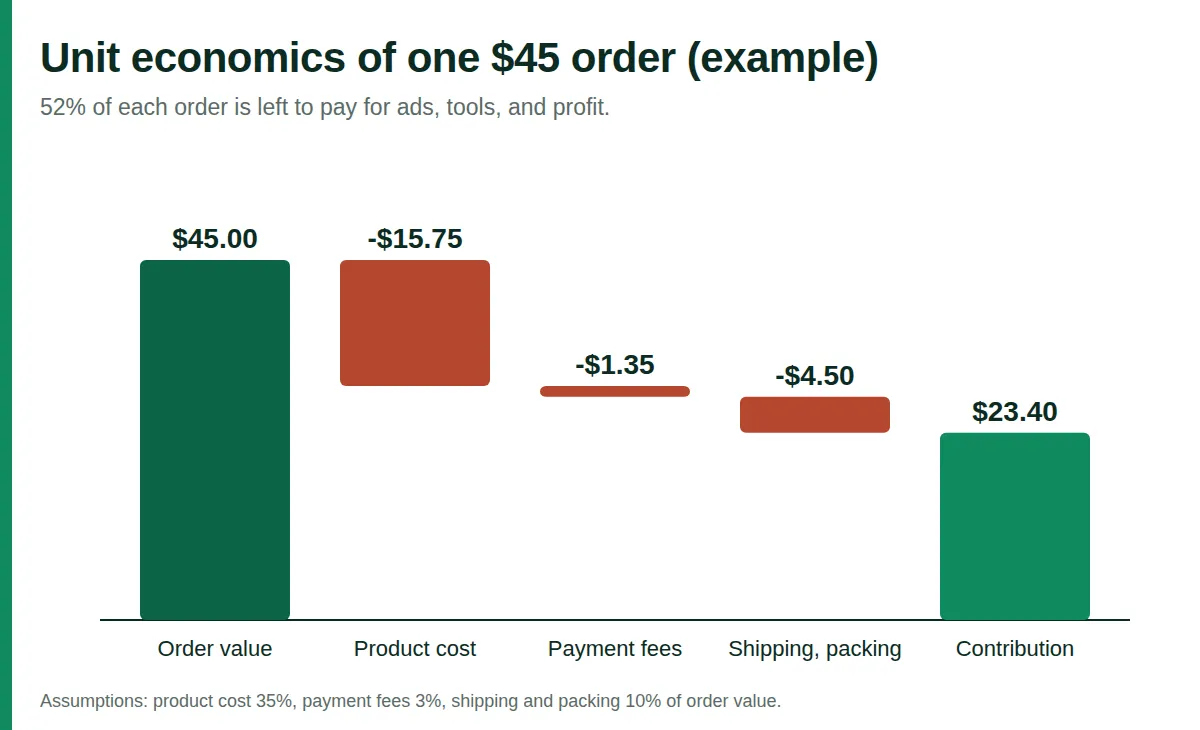
- Product cost: 35% of sales. Payment fees: 3%. Shipping and packing, net of what customers pay: 10%. Total variable cost: 48%, which leaves a 52% contribution margin, or $23.40 per order.
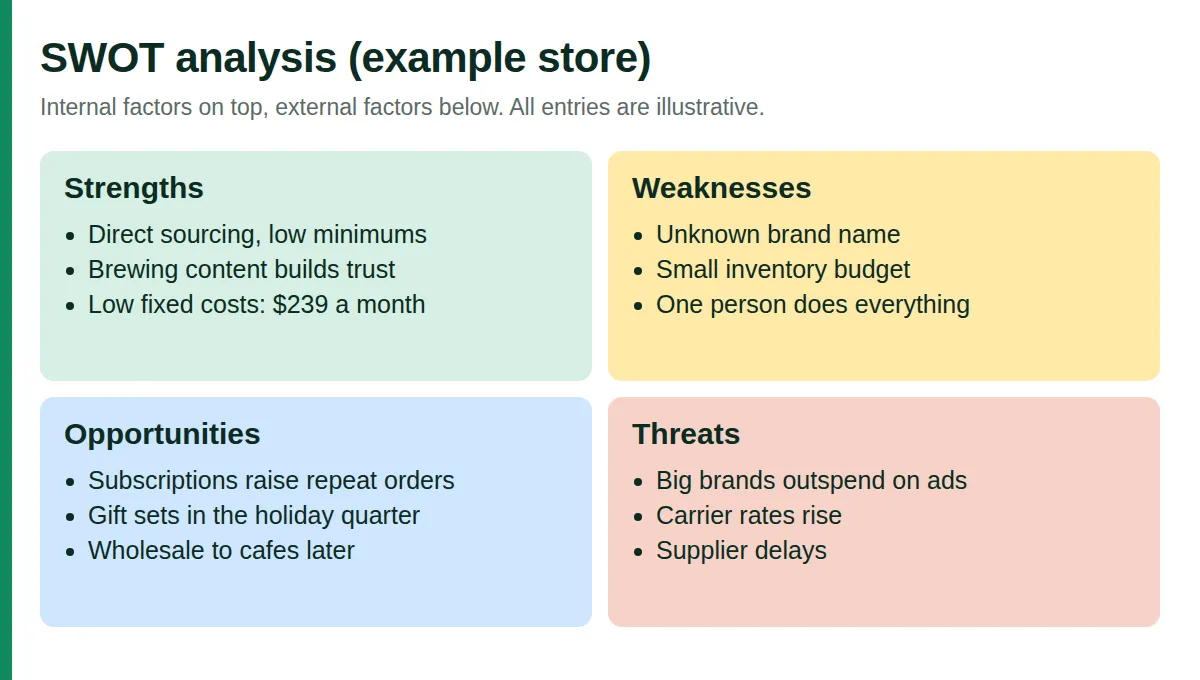
- Fixed costs: $239 a month (Shopify plan about $29, apps $60, email and tools $30, bookkeeping $120). Check Shopify pricing for current plan prices before you budget.
- Traffic grows from 1,000 sessions in month one to 13,500 in month twelve, with conversion rising from 0.9% to 2.2%.
1. Executive summary
What this section is for
The executive summary is the one page most readers will actually read. The SBA says it should briefly tell the reader what your company is and why it will be successful, and include financial information and growth plans if you are seeking financing. Write it last, once the numbers exist.
Questions to answer
- What do you sell, and to whom?
- Why will customers pick you over alternatives?
- What revenue and profit do you expect, and when?
- How much money do you need, and what will it pay for?
Fill-in template
Template:
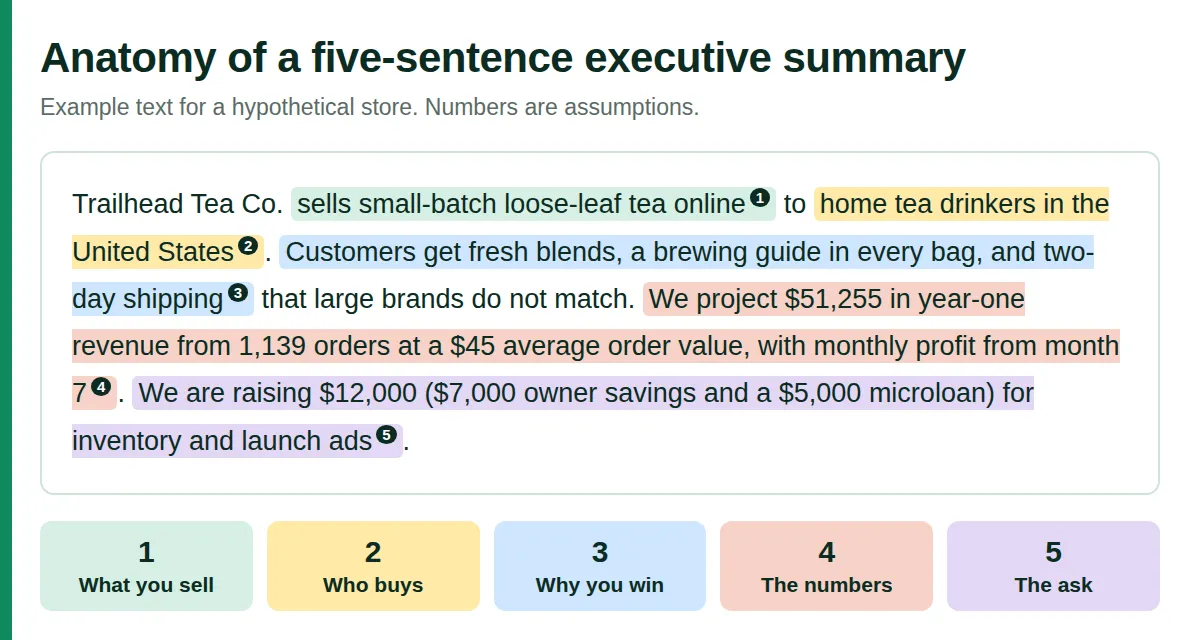
[Business name] sells [products] online to [target customer] in [region].
Customers choose us because [main advantage, in one sentence].
In year one we expect [revenue] from [number] orders at an average order value of [AOV], with monthly profit from month [X].
We are seeking [amount] from [sources] to fund [inventory, ads, tools].
Example: Trailhead Tea Co.
The text below is illustrative, and the numbers are the assumptions listed above.
2. Company description
What this section is for
This section tells readers who is behind the business and what problem it solves. The SBA advises being specific about your target audience and highlighting the competitive advantages that will make the business a success.
Questions to answer
- What is the legal structure (sole proprietor, LLC, corporation)?
- What problem do you solve, and for whom?
- Who runs the business, and what experience do they bring?
- Where do you operate, and which platform runs your store?
The SBA has a short guide to choosing a business structure. If you do not have a name yet, start with our lists of business name ideas and small business name ideas.
Fill-in template
Template:
[Business name] is a [legal structure] founded in [year] and based in [city, state]. We sell [products] through a [platform] store at [domain].
We solve [customer problem] by [how you solve it]. Our edge is [advantage: sourcing, speed, design, price, service].
[Founder name] leads the business and brings [relevant experience]. Gaps in the team: [roles you will hire or outsource].
Example: Trailhead Tea Co.
Trailhead Tea Co. is a single-member LLC (assumed) based in Portland, Oregon. It sells small-batch loose-leaf tea through a Shopify store. It solves a simple problem: supermarket tea tastes flat, and large online tea sites rarely show where a tea was grown. The founder worked in food retail for six years (fictional) and blends and packs orders from a rented 200-square-foot room.
3. Market research and target customer
What this section is for
Market research shows that real people want what you plan to sell. The SBA separates secondary research (existing sources such as industry reports and Census data, which save time on general questions) from primary research (surveys, interviews, and focus groups that reveal what your specific audience prefers).
Questions to answer
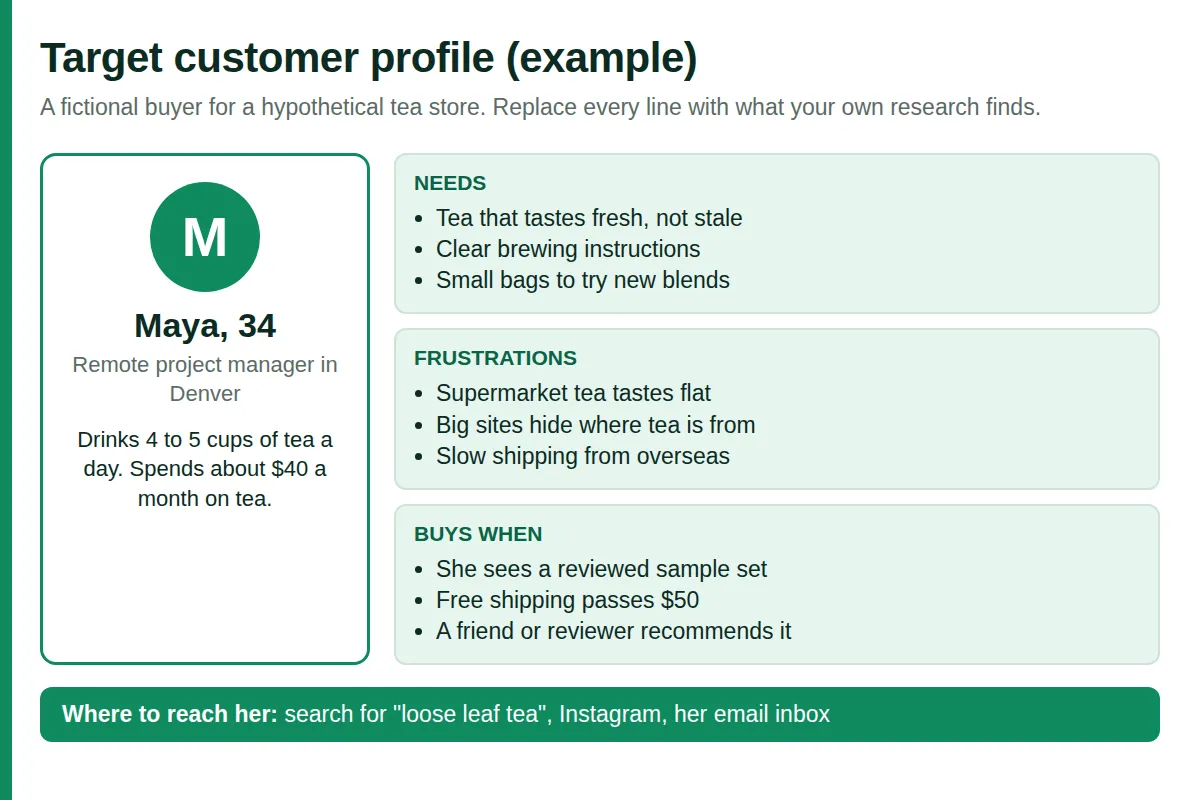
- Who is your ideal customer, in concrete terms (age, location, habits, budget)?
- What problem do they have today, and what do they do about it?
- Where do they search, shop, and spend time online?
- Is the market growing, and how will you test demand before buying inventory?
The Census Bureau's 17.1% e-commerce share tells you shoppers buy online in general, not whether they want your product. For that you need narrow evidence: search volume, competitor reviews, and conversations with real buyers. Still choosing what to sell? Our list of ecommerce business opportunities can help you shortlist.
Fill-in template
Template:
Our ideal customer is [description: age, location, job, habits]. She or he spends about [amount] a [period] on [category].
Their main frustrations are [1], [2], and [3]. They currently solve this by [competitor or workaround].
They search for [keywords], shop on [places], and trust [sources of recommendation].
Before buying inventory we will test demand by [waitlist, pre-orders, small ad test] and need [target number] by [date].
Example: Trailhead Tea Co.
The example plan claims no market size it cannot support. It describes one buyer and sets a demand test: a landing page and a $300 ad test must produce 300 email sign-ups within 30 days before the founder places the full opening inventory order (all figures are assumptions).
4. Competitor analysis
What this section is for
Competitor analysis shows where you can win. The SBA suggests asking what successful competitors do, why it works, and whether you can do it better. It also lists what to assess: market share, strengths and weaknesses, your window of opportunity to enter, barriers to entry, and indirect competitors that could affect you.
Questions to answer
- Who are your direct competitors, and who are the indirect ones (marketplaces, big retailers, substitutes)?
- What do they charge, and how do they ship?
- What do their reviews praise and complain about?
- Where is the gap that you can fill?
Fill-in template
Template:
Our main competitors are [A], [B], and [C]. Indirect alternatives include [D].
Compared with them we are [cheaper, faster, more specialized, better designed] in [area].
Our competitors are weak at [gap], which we address by [action].
The biggest barrier to entry is [barrier], and we will handle it by [plan].
Example: Trailhead Tea Co.
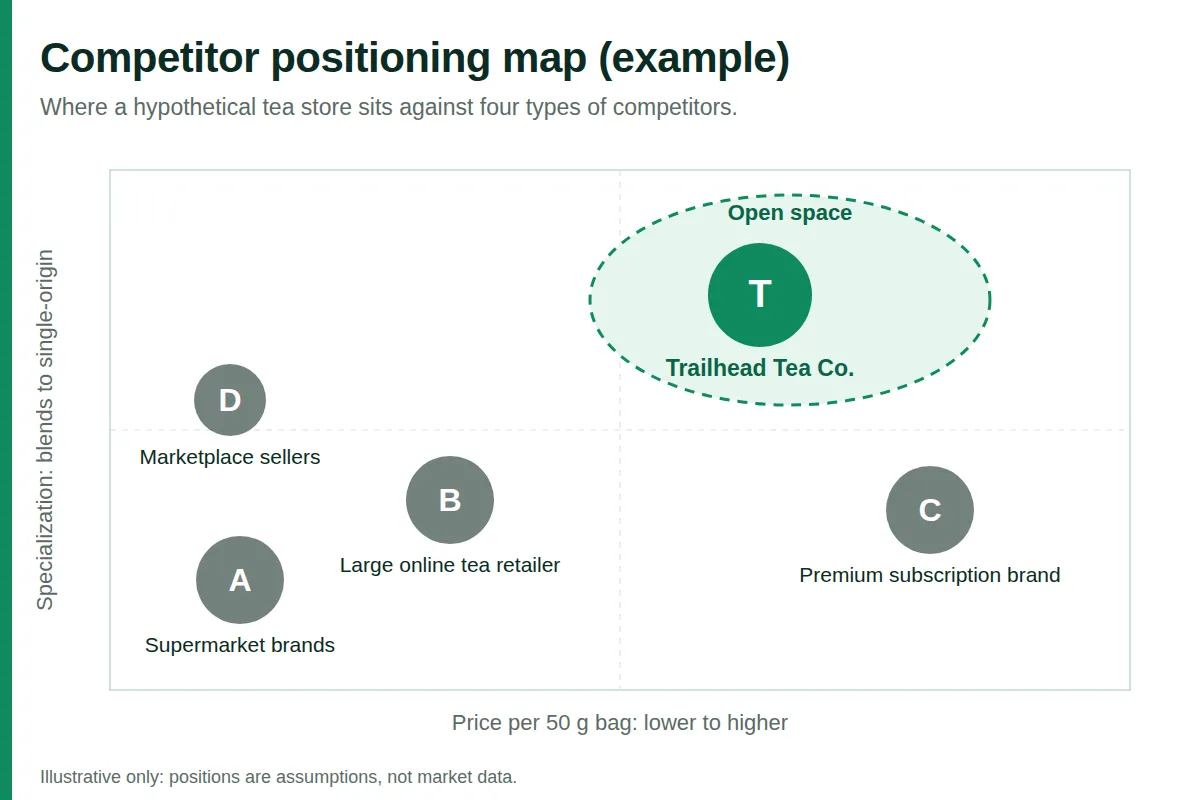
The table lists four competitor types. They are invented to show the format. In your plan, name real competitors and note the date you checked their prices.
| Competitor type | Typical price per 50 g (assumed) | Strength | Weakness | Our angle |
|---|---|---|---|---|
| Supermarket brands | $3 to $5 | Cheap, everywhere | Flat flavor, no origin story | Fresher tea with clear sourcing |
| Large online tea retailer | $7 to $11 | Wide range, strong SEO | Slow shipping, generic content | Two-day dispatch, brewing guides |
| Marketplace sellers | $4 to $8 | Built-in traffic | Inconsistent quality | Own brand and customer relationship |
| Premium subscription brand | $12 to $16 | Loyal fans, strong design | High price, fixed selection | Mid-premium price, choose-your-own bags |
5. Products and pricing
What this section is for
This section lists what you sell, what it costs you, and what you charge. The SBA asks plans to explain the products or services offered and the benefit to customers. For an online store the key number is margin: price minus product cost, shipping, and fees.
Questions to answer
- Which products launch first, and why those?
- What does each unit cost you landed, delivered to your door?
- What price does the market tolerate, based on competitors?
- What is your margin after shipping and payment fees?
A simple pricing formula: price = product cost ÷ (1 − target gross margin). A $4.20 cost with a 70% target margin gives $4.20 ÷ 0.30 = $14.00. Test the result against competitor prices before you commit.
Fill-in template
Template:
We launch with [number] products: [list]. Each solves [customer need] by [benefit].
Landed cost per unit is [cost]. We price at [price], a gross margin of [percent].
Our average order will contain about [number] items, for an average order value of [AOV].
We will review prices every [period] or when supplier costs change by more than [percent].
Example: Trailhead Tea Co.
| Product (assumed) | Price | Product cost | Gross margin |
|---|---|---|---|
| Everyday blend, 100 g | $14.00 | $4.20 | 70% |
| Single-origin tea, 50 g | $16.00 | $5.60 | 65% |
| Sampler set, five 10 g bags | $22.00 | $8.80 | 60% |
| Gift set | $48.00 | $19.20 | 60% |
Across a typical basket, product cost averages 35% of sales. After payment fees (3%) and net shipping and packing (10%), each $45 order leaves $23.40 for ads, tools, and profit. That number caps how much you can spend to win an order.
6. Marketing and sales plan
What this section is for
The marketing plan explains how strangers become customers, and how customers come back. The SBA notes there is no single way to approach a marketing strategy, and that it should evolve to fit your needs. Tie every channel to a budget and a metric.
Questions to answer
- Which two or three channels will you focus on first?
- What will you spend on each, and what result do you expect?
- What conversion rate and AOV are you assuming, and why?
- How will you bring buyers back (email, subscriptions, loyalty)?
Be careful with the conversion rate, because it multiplies everything else. Shopify's conversion rate guide cites a global average of 2.66% from Dynamic Yield (2026) and a lower 1.4% from Statista (first quarter 2026), and category figures such as 4.58% for food and beverage and 0.63% for luxury and jewelry. New stores often start below average, so the example begins at 0.9%.
Also plan for shoppers who leave. The Baymard Institute's analysis of 50 studies puts the average cart abandonment rate at 70.22%. In its research, 40% of abandoners cited extra costs such as shipping, taxes, or fees, and 18% were put off by having to create an account. Showing shipping costs early and offering guest checkout are cheap fixes. For seasonal campaigns, see our Christmas marketing ideas, and for organic traffic, our guide to SEO tips for Shopify.
Fill-in template
Template:
Our focus channels are [channel 1], [channel 2], and [channel 3]. Month-six budget: [amount] in total.
We assume a [percent] conversion rate and a [AOV] average order value, based on [source].
We measure success with [metrics] and review them every [week or month].
To bring customers back we will [email flows, subscriptions, loyalty offer], aiming for [percent] repeat purchase within [period].
Example: Trailhead Tea Co.
| Channel | Job | Month-6 budget | Metric to watch |
|---|---|---|---|
| Search and shopping ads | Capture people already looking for loose-leaf tea | $450 | Return on ad spend |
| Social ads | Introduce the brand with sampler sets | $350 | Cost per purchase |
| Creator samples | Reviews and trust | $200 | Orders using creator codes |
| Content and SEO | Brewing guides that rank over time | $200 | Organic sessions |
| Welcome series, restock reminders | $0 extra (in tool costs) | Share of revenue from email |
The break-even rule: with a 52% contribution margin, the store needs a return on ad spend of at least 1 ÷ 0.52 = 1.92 to break even on the first order. In other words, paid acquisition must cost less than $23.40 per order. In the example, blended marketing spend averages $14.75 per order across the year ($16,800 ÷ 1,139 orders), which leaves room for fixed costs and profit.
7. Operations and fulfillment
What this section is for
Operations explain how an order becomes a delivered package. Shopify's guide says this part of the plan should document suppliers, production capacity, shipping and fulfillment partners, and inventory management.
Questions to answer
- Who supplies your products, and what are the minimum orders and lead times?
- Will you ship yourself or use a fulfillment partner, and when does that change?
- What are your shipping rates, delivery promise, and return policy?
- Which tools run the store (platform, checkout, email, bookkeeping)?
For checkout and conversion tools, see our roundup of the best checkout apps for Shopify. If you are weighing building the store yourself against hiring help, read Shopify expert vs. DIY. Before launch, run through our Shopify launch checklist and the Shopify Launch Check app guide.
Fill-in template
Template:
Suppliers: [supplier names, products, minimum order, lead time, payment terms].
Fulfillment: we pack and ship from [location] until we reach [orders per week], then move to [partner or larger space].
Shipping and returns: we ship via [carriers] in [days], charge [rates or free-shipping threshold], and accept returns within [days].
Tools: [platform, apps, email, accounting] at a cost of [amount] a month.
Example: Trailhead Tea Co.
Two importers supply the tea with a 5 kg minimum per product and a three-week lead time (assumed). The founder packs orders in the rented room and promises dispatch within two business days. Free shipping starts at $50, which nudges orders toward $45 and above. Unopened bags can be returned within 30 days. At 60 orders a week, the plan calls for evaluating a fulfillment partner.
8. Financial plan and projections
What this section is for
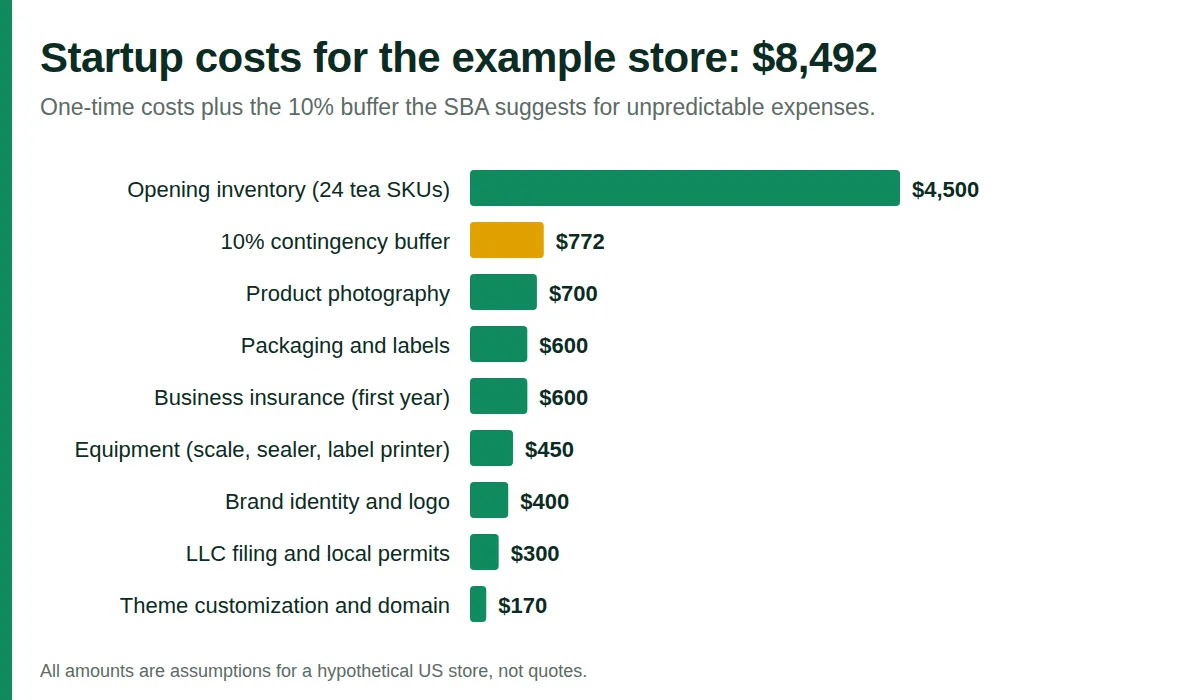
The financial plan converts every earlier section into numbers: startup costs, a revenue forecast, expenses, and break-even. For lenders the SBA expects five-year projections, and it suggests quarterly or even monthly projections for year one. For startup costs, it separates one-time expenses from monthly ones and recommends adding about 10% to cover costs you cannot predict.
Questions to answer
- What do you need to spend before the first sale?
- How many orders will you get each month, and at what average order value?
- What are your variable and fixed costs?
- When does each month turn profitable, and when does cash bottom out?
Formulas to use
- Revenue = sessions × conversion rate × average order value.
- Contribution per order = AOV × (1 − variable cost percentage).
- Monthly profit = orders × contribution per order − marketing − fixed costs.
- Break-even orders per month = (fixed costs + marketing) ÷ contribution per order.
- Funding needed = startup costs + the lowest point of cumulative cash.
Fill-in template
Template:
Startup costs: [total], made up of [major items]. We add a [10]% buffer of [amount].
Year-one revenue: [amount] from [orders] orders at [AOV]. Variable costs: [percent] of revenue. Fixed costs: [amount] a month.
We expect monthly profit from month [X] and cumulative break-even in month [Y]. The lowest cumulative cash position is [amount] in month [Z].
Example: startup costs
| One-time startup cost (assumed) | Amount |
|---|---|
| Opening inventory (24 tea SKUs) | $4,500 |
| Product photography | $700 |
| Packaging and labels | $600 |
| Business insurance (first year) | $600 |
| Equipment (scale, sealer, label printer) | $450 |
| Brand identity and logo | $400 |
| LLC filing and local permits | $300 |
| Theme customization and domain | $170 |
| Subtotal | $7,720 |
| 10% contingency buffer (SBA suggestion) | $772 |
| Total startup cost | $8,492 |
Example: 12-month forecast
The table applies the formulas to the assumptions above. Contribution is revenue after product cost, payment fees, and shipping (52% of revenue). Net excludes owner pay, income tax, and the opening inventory purchase, which is treated as working capital.
| Month | Sessions | Conv. rate | Orders | Revenue | Contribution | Marketing | Net | Cumulative |
|---|---|---|---|---|---|---|---|---|
| Jan | 1,000 | 0.9% | 9 | $405 | $211 | $900 | -$928 | -$928 |
| Feb | 1,500 | 1.0% | 15 | $675 | $351 | $900 | -$788 | -$1,716 |
| Mar | 2,100 | 1.1% | 23 | $1,035 | $538 | $900 | -$601 | -$2,317 |
| Apr | 2,800 | 1.2% | 34 | $1,530 | $796 | $1,000 | -$443 | -$2,760 |
| May | 3,500 | 1.3% | 46 | $2,070 | $1,076 | $1,100 | -$263 | -$3,023 |
| Jun | 4,300 | 1.4% | 60 | $2,700 | $1,404 | $1,200 | -$35 | -$3,058 |
| Jul | 5,200 | 1.5% | 78 | $3,510 | $1,825 | $1,300 | $286 | -$2,772 |
| Aug | 6,100 | 1.6% | 98 | $4,410 | $2,293 | $1,400 | $654 | -$2,118 |
| Sep | 7,100 | 1.7% | 121 | $5,445 | $2,831 | $1,500 | $1,092 | -$1,026 |
| Oct | 8,200 | 1.8% | 148 | $6,660 | $3,463 | $1,600 | $1,624 | $598 |
| Nov | 10,500 | 2.0% | 210 | $9,450 | $4,914 | $2,200 | $2,475 | $3,073 |
| Dec | 13,500 | 2.2% | 297 | $13,365 | $6,950 | $2,800 | $3,911 | $6,984 |
| Year | 65,800 | 1,139 | $51,255 | $26,652 | $16,800 | $6,984 |
Check one month by hand. In June: 4,300 sessions × 1.4% = 60 orders; 60 × $45 = $2,700 revenue; $2,700 × 52% = $1,404 contribution; $1,404 − $1,200 marketing − $239 fixed = −$35. Break-even orders that month were ($239 + $1,200) ÷ $23.40, or about 62, so the store was two orders short.
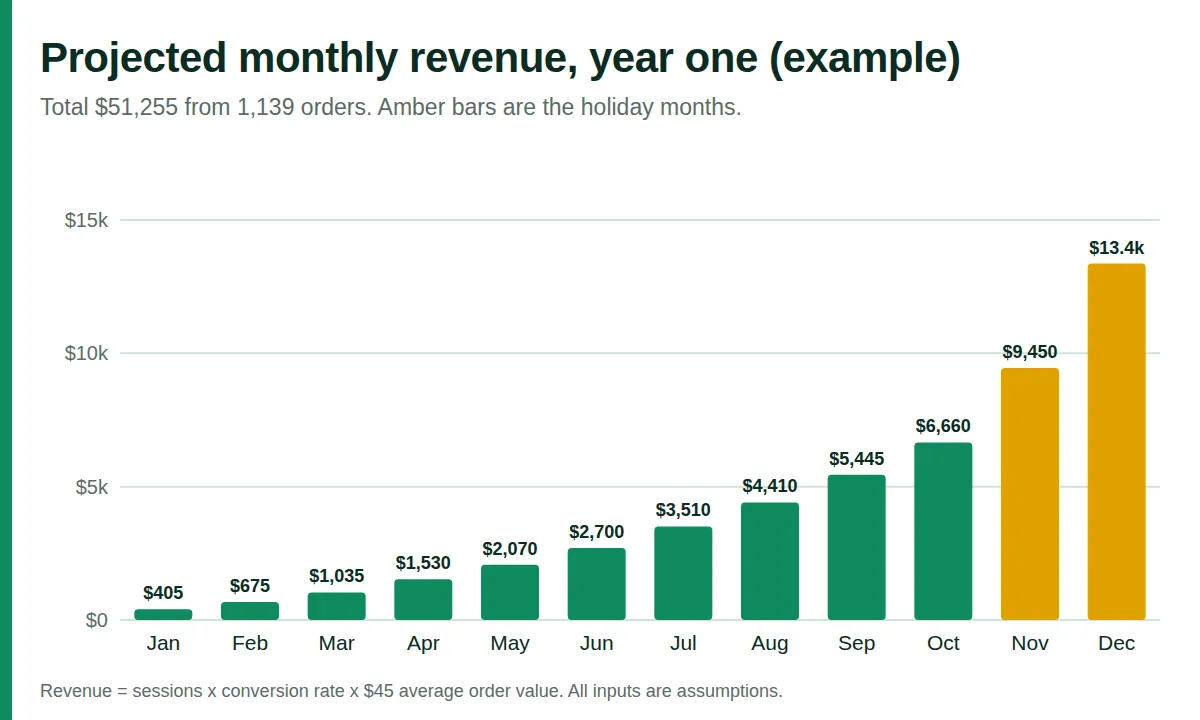
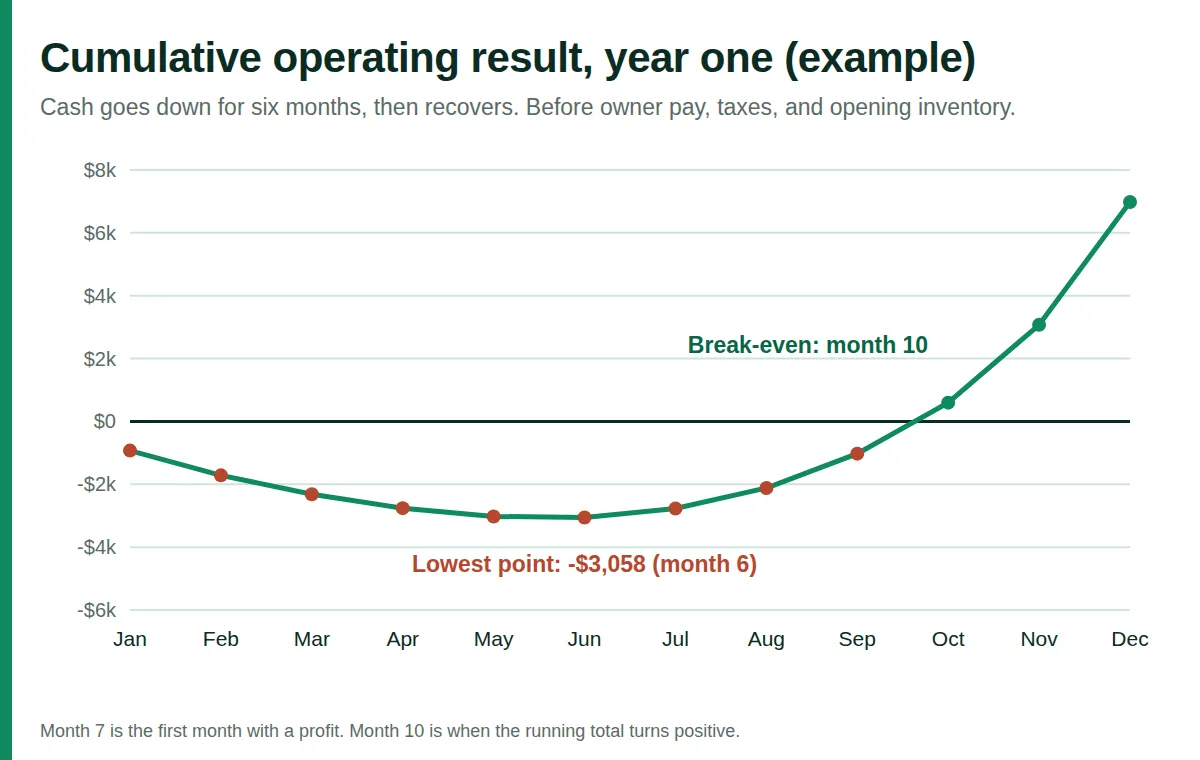
Treat the forecast as a model you can change, not a promise. Re-run it with a worse case (conversion 30% lower, ad costs 20% higher) to see what a bad quarter costs. For platform costs, see our Shopify Grow plan pricing breakdown.
9. Funding
What this section is for
The funding section states how much money you need, what it pays for, and where it will come from. The SBA says a funding request should outline needs over time, specify debt versus equity, and explain the intended use of funds. Lenders also weigh your credit history and your break-even analysis.
Questions to answer
- How much do you need in total, and by when?
- How much is your own money?
- Which outside options fit (loans, microloans, revenue-based funding, investors)?
- How will you repay, and what happens if sales are 30% below plan?
The SBA lists these routes: SBA-guaranteed loans, microloans, grants, self-funding, venture capital, crowdfunding, and investment programs. SBA microloans go up to $50,000 (the average is about $13,000), are made through nonprofit intermediary lenders, and can fund working capital, inventory, supplies, and equipment, but not existing debt or real estate. Once a store is live, Shopify Capital offers funding that Shopify says is repaid as a percentage of daily sales over up to 18 months. It requires at least 90 days of selling on Shopify, and it is currently offered in the United States, Canada, the United Kingdom, and Australia. Read the current terms first.
Fill-in template
Template:
We need [total] to cover startup costs of [amount] and a cash cushion of [amount] for the months before break-even.
Funding sources: [owner savings amount], [loan or other source and amount].
Repayment: [terms]. If sales run [30]% below plan we will [cut ad spend, delay inventory orders, seek extension].
Example: Trailhead Tea Co.
Startup costs of $8,492 plus the $3,058 cash low point in month 6 means the store needs about $11,550. The plan asks for $12,000: $7,000 from owner savings and a $5,000 microloan (assumed terms). The extra $450 is a cushion.
10. Milestones and KPIs
What this section is for
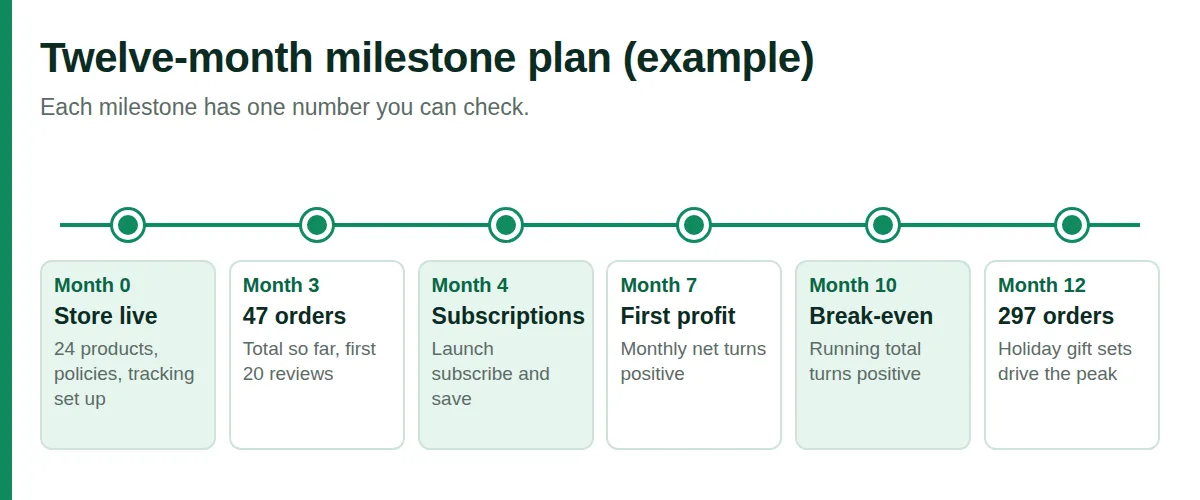
Milestones turn the plan into a schedule. KPIs (key performance indicators) are the numbers you check to see whether you are on track. Shopify's guide advises attaching a metric and a review schedule to every goal.
Questions to answer
- What must be true at month 3, 6, 9, and 12?
- Which five to seven numbers will you track every week?
- What trigger tells you to change course?
- Who is responsible for each number?
Fill-in template
Template:
Month 3: [milestone with a number]. Month 6: [milestone]. Month 12: [milestone].
Weekly KPIs: [list]. Monthly review date: [day].
If [metric] falls below [threshold] for [period], we will [action].
Example: Trailhead Tea Co.
| KPI | How to calculate it | Month-6 target (assumed) | Where to find it |
|---|---|---|---|
| Conversion rate | Orders ÷ sessions | 1.4% | Shopify analytics |
| Average order value | Revenue ÷ orders | $45 | Shopify analytics |
| Blended cost per order | Marketing spend ÷ orders | Under $23.40 (breakeven cap); plan: $20 | Ad accounts and Shopify |
| Contribution margin | (Revenue − variable costs) ÷ revenue | 52% | Bookkeeping software |
| Repeat purchase rate | Customers with 2+ orders ÷ all customers | 15% | Shopify customer reports |
Shopify's reports and analytics documentation shows where to find the sales and traffic data behind these numbers.
FAQ
What should an ecommerce business plan include?
At minimum: an executive summary, company description, market research, competitor analysis, products and pricing, marketing and sales plan, operations and fulfillment, financial plan, funding request, and milestones. Shopify's ten-step guide covers the same ground and adds a logistics and operations plan.
Do I need a business plan to start a Shopify store?
No law requires one. But a plan forces you to check margins, shipping costs, and ad costs before you buy inventory, and lenders such as SBA-backed lenders expect one.
How much money do I need to start an online store?
It depends on your product. The example store needs about $8,492 in startup costs and about $11,550 including the cash low point, but a store with no inventory could need far less. The SBA recommends counting at least one year of monthly expenses and adding roughly 10% for surprises.
What conversion rate should I use in my projections?
Start conservative and cite a source. Shopify's guide reports a global average of 2.66% (Dynamic Yield, 2026) and 1.4% (Statista, first quarter 2026), with large differences by category. A new store with no reviews often converts below average, so ramp up gradually.
How do I calculate break-even for an online store?
Divide your monthly fixed costs plus marketing spend by your contribution per order. Contribution per order is average order value minus product cost, payment fees, and net shipping. In the example, that is ($239 + $1,200) ÷ $23.40, or about 62 orders in a month with $1,200 of marketing.
How often should I update my business plan?
Review it quarterly and after big changes such as a new supplier, a price change, or a shipping rate increase. Compare actual orders, conversion, and margin with the forecast, and adjust the assumptions.
Sources
- U.S. Census Bureau, Quarterly Retail E-Commerce Sales, second quarter 2026 (seasonally adjusted share of total retail sales and quarterly dollar amount): census.gov/retail/ecommerce.html, also published as FRED series ECOMPCTSA.
- U.S. Bureau of Labor Statistics, Business Employment Dynamics, survival of private-sector establishments by opening year (table accessed October 2026): bls.gov/bdm.
- U.S. Small Business Administration, Write your business plan.
- U.S. Small Business Administration, Calculate your startup costs.
- U.S. Small Business Administration, Market research and competitive analysis.
- U.S. Small Business Administration, Fund your business and Microloans.
- Shopify, How to write a business plan in 10 steps (2026).
- Shopify, Ecommerce conversion rate benchmarks (2026), citing Dynamic Yield and Statista.
- Shopify, Shopify Capital and pricing, accessed October 2026.
- Baymard Institute, Cart abandonment rate statistics, updated September 2025.
- SCORE, Business plan template for a startup business.